About Radical AI:
Radical AI is on a mission to discover the materials of the future. By combining advanced AI with autonomous labs, the New York-based team accelerates processes that once took 20 years and $100 million into a fraction of the time. The company is able to generate over 300 novel materials in 16 weeks while meeting key customer goals and outperforming legacy materials. Radical AI continues to scale throughput and deepen its technical moat.
To achieve this, Radical AI is building a fully automated self-driving lab where its AI doesn’t just suggest experiments; it executes them 24/7. The system gathers all relevant data on successes and failures and feeds this information back into the system to keep refining hypotheses until performance goals are met. While experts predicted it would take two years to assemble such a facility, the Radical team was operational in just nine months. Central to this speed was a strategic partnership with Zaber Technologies who provided motion devices to build reliable, repeatable automation stations.
The Engineering Shortcut: Virtual Integration & Plug-and-Play Precision
A key challenge in automating a high-speed lab is the tuning gap, i.e., the weeks typically lost to synchronizing motors, sensors, and drives. Radical AI bypassed this hurdle by using Zaber’s digital ecosystem long before the physical hardware arrived on the bench.
- CAD-Ready Configuration: Before placing an order, the team used Zaber’s published technical specifications and SolidWorks CAD models to explore which lengths and models fit their footprint.
- The Virtual Verification: By using the online online virtual device simulator, Radical AI’s software team began programming the digital twin versions of their devices from their PLCs before the boxes were even shipped. This allowed the mechanical and software environments to be fully prepared, moving the team from unboxing to autonomous testing in a single afternoon.
- Plug-and-Play Performance: Radical AI chose pre-tuned integrated stages to eliminate the need for manual servo gain or PID loop tweaking. The hardware arrived ready to perform at rated specifications.
- Advance Device Tuning: While Zaber products are designed to work out of the box, the system settings are configurable. Radical AI utilized the Oscilloscope tool in the Zaber Launcher application suite to characterize motor performance and write custom homing sequences. This transparency allowed the engineers to optimize motion for the highly specific requirements of their autonomous stations.
Three Stations: Three Different Challenges
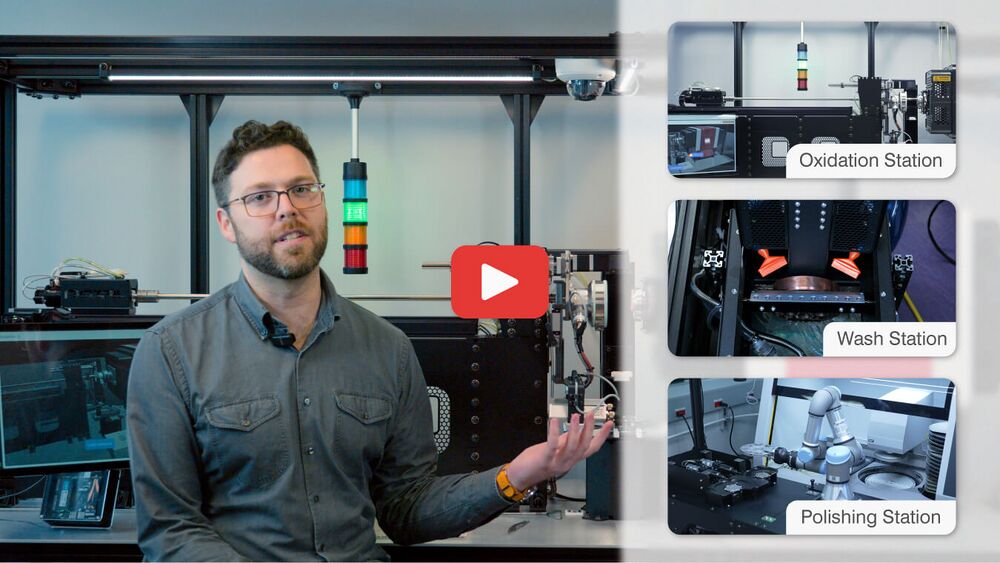
Across three stations in the lab, Radical AI encountered varying challenges. Despite the differing requirements of heat, weight, and stability, they utilized a unified Zaber ecosystem to solve all three.
The Oxidation Station: Managing 1500°C Extremes
- The Goal: Move samples into a 1500 °C+ furnace for a specific time to test oxidation resistance.
- The Challenge: Placing samples in ultra-high-heat furnaces without heat-soaking the mechanical components.
- The Solution: An XZ automated motion system that moves samples up and down and rapidly in and out of the furnace zone. This advances the sample through controlled heating cycles while minimizing drive component exposure to the damaging effects of radiant heat.
- The Z axis: a high-speed belt drive linear stage for sample positioning up and down.
- The X axis: a high-speed screw-driven linear stage to move the sample in and out of the furnace zone.
- Why it works: The discovery process relies on precise exposure times, and sub-micron repeatability is non-negotiable. Zaber’s precision stages ensure that every single sample is placed in the same sweet spot of the furnace, eliminating drift as a variable in the AI’s data set.
- Intelligent Protection: The stages equipped with motor-mounted encoders enable the system to maintain constant slip and stall detection. If the extreme heat ever caused the device to stall, the Zaber devices would send a signal to the AI and prevent damage to expensive furnace hardware.
The Wash Station: Handling Heavy Payloads in Wet Zones
- The Goal: Clean the synthesis crucibles in an ultrasonic bath to prevent cross-contamination in the alloying process.
- The Challenge: Lifting an 8.5kg assembly—including samples, mounting plates, and sensors—24/7 in a wet, high-duty-cycle environment.
- The Solution: A high-thrust linear stage with a fine-pitch leadscrew was implemented to handle the lift in and out of the cleaner. To shield the hardware from the damaging effects of moisture and chemical vapour, the team utilized a stainless steel extension plate paired with the stage’s integrated dust cover.
- Why it Works: In a self-driving lab, the most expensive component is downtime. The leadscrew is self-locking, allowing the stage to hold the 8.5kg load securely without a brake, even if power is cut. This ensures the system remains stable during power cycles.
- Industrial Reliability: The dust cover allows the precision device to sit safely above the splashing and steam of the ultrasonic tank while the extension reaches into the wet zone. By using hardware designed for high duty cycles, the team spends their time analyzing alloys rather than performing maintenance.
The Sample Polishing Station: High-Torque Stability & Rigid Alignment
- The Goal: Align sample cassettes precisely and hold them perfectly still while the pneumatic screwdrivers tighten set screws to secure the samples.
- The Challenge: Space and stability. The hardware had to be small enough to be tucked under the table to keep the workspace clear for robotic grippers, yet strong enough to resist the lateral force of a pneumatic screwdriver without drifting.
- The Solution: Radical AI chose Zaber’s NEMA 23 stepper motors with integrated power-off brakes to turn the cassettes during the sample loading and unloading process.
- Why it Works: Despite their small footprint, these motors act as the structural locking pin for the entire station. Once the motor rotates the cassette into position, the integrated brake engages to hold the sample as an immovable object.
- Dual-Purpose Engineering: This setup turns a high-precision motion device into a rigid structural mount the moment the motor stops moving. By shielding the internal components from the damaging effects of high-torque stress through the use of a physical brake, the system ensures the cassettes remain perfectly aligned even under the aggressive force of the pneumatic tools.
The Results: Scaling from Concept to Reality
By leveraging a unified hardware and software ecosystem, Radical AI was able to scale from a concept to a functional lab in record time.
"In the startup world, speed is everything. We needed to move from concept to a fully operational lab in nine months, not two years. Zaber’s focus on time-saving features—from virtual simulation and pre-tuned hardware to a unified API across a massive portfolio—eliminated the typical troubleshooting and integration delays. But speed is useless without precision; Zaber provides the reliable, repeatable systems we need to reach our goals." — Radical AI Engineering Team
Key Business Outcomes
- Data Integrity: The high repeatability of the motion systems ensures the AI measures scientific breakthroughs, not mechanical inconsistencies or positioning drift.
- Extreme Throughput: The lab successfully generated 300+ novel materials in 16 weeks, meeting rigorous customer performance goals.
- Industrial-Grade Reliability: With discovery cycles running 24/7, Zaber’s rugged design and feedback control ensured the system functioned properly, even in the demanding environments of the furnace and wash stations.
- Accelerated Deployment: While experts predicted a two-year build, Radical AI was fully operational in just nine months.
The Technical Advantage
- Off-the-Shelf Versatility: Radical AI met the demands of 1,500°C temperatures and 8.5kg payloads without a single custom-engineered part, avoiding the high costs and lead times of bespoke hardware.
- Pre-Tuned Integration: By choosing integrated stages that work at rated specifications the moment they are plugged in, the team avoided the hidden engineering costs and delays of manual motor tuning and PID loop calibration.
- Rapid Deployment: In the startup world, a 6-month lead time for hardware is a death sentence. Zaber’s ability to deliver standard precision stages with 5-day lead times meant the hardware was on the bench as fast as the code was written.
- A Unified API Ecosystem: Because every device runs on the open-source Zaber Motion Library API, the software team only had to solve the motion problem once. After the first station was coded, the logic for the next two was essentially a copy-paste integration.
- Simplified Wiring (Daisy-Chaining): The ability to daisy-chain power and data between stages drastically reduced electrical cabinet complexity.
Ready to Accelerate Your Lab Automation?
By leveraging instant access to CAD models, virtual device simulators, an easy-to-use software library, and precision hardware that works right out of the box, you can skip many setup bottlenecks and move from unboxing to execution in a fraction of the time.