
Motorized Rotation of Polarizing Filters Enable Automated Acquisition of Large Datasets
Published on Aug. 05, 2026
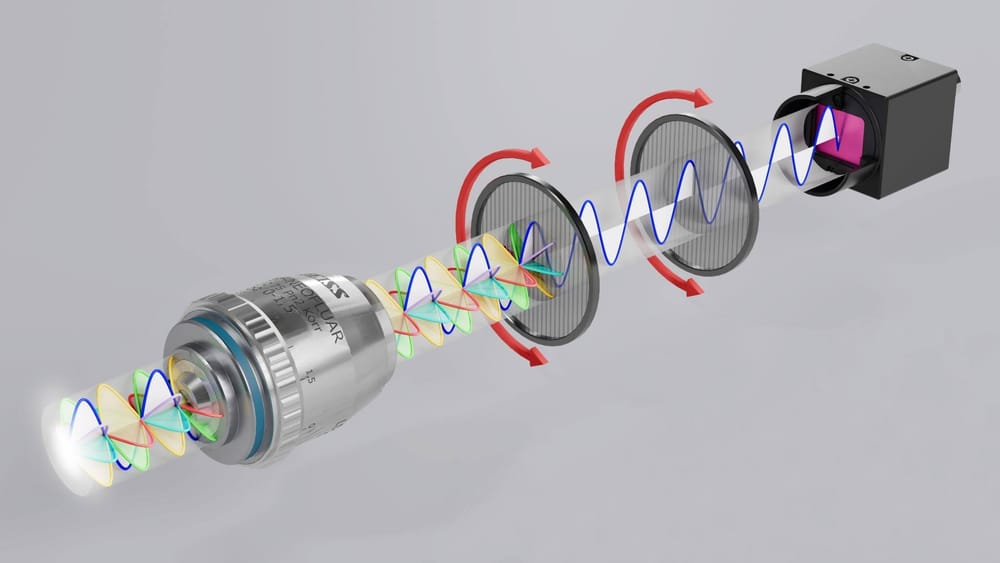
The Challenge:
Sensing the degree and angle of linearly polarized light across a sample provides material scientists with a fast, non-contact means of material characterization. Detecting grain boundaries in metals, identifying microplastics in biological materials, and visualizing internal stresses in materials are all enabled by sensing polarized light.
Capturing high-resolution polarimetry data across large sample areas requires automation, yet off-the-shelf microscopes with integrated motorized polarizing filters remain scarce.
The Solution:
A tailored solution delivering a fully motorized, high-resolution polarimetry system based on a Nucleus inverted automated microscope with a pair Zaber motorized rotary stages integrated into the optical path. Sample positioning, polarising filter rotation and image acquisition can be controlled though our free Zaber launcher application. Advanced automation is achieved using the Zaber Motion Library API, which is available for Python, C++, C#, Labview, MATLAB and more.
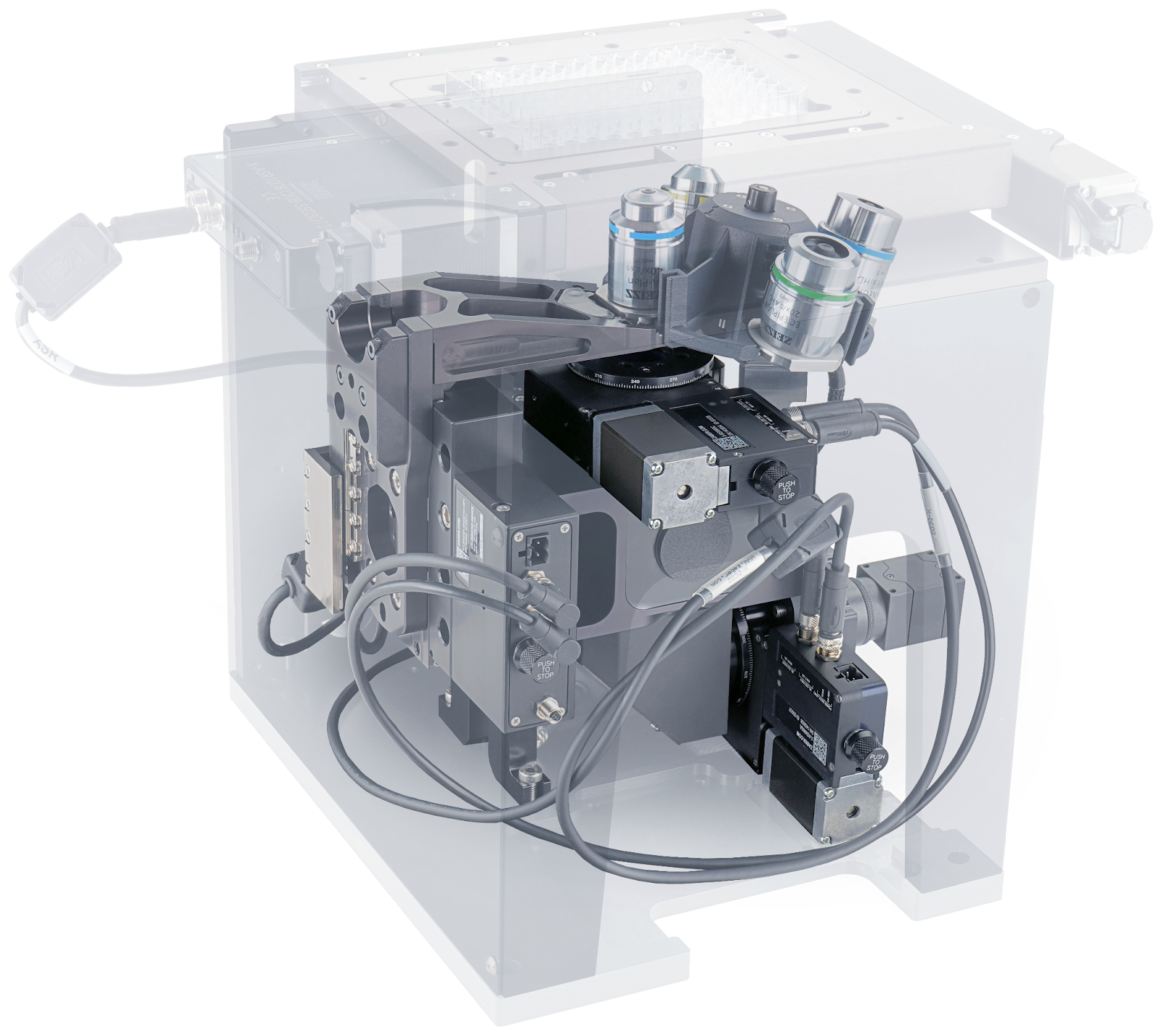
Figure 1. A Zaber Nucleus inverted microscope with motorized polarizing filters mounted between the objective and the tube lens and between the tube lens and the camera mount. The rotation of the polarizing filters can be independently controlled.
The Engineering Approach:
The low profile and open aperture of Zaber’s X-RSW60A rotary stages allows them to be inserted into the optical path without altering any of the key optical distances for the infinity space or between the tube lens and the image sensor plane. Special care was taken to minimize internal reflections in the optical path when integrating these rotary stages. Optical alignment is critical to imaging performance so custom features were included in the design to enable fine tuning the positioning of each rotary axis during final assembly of the microscope system.
Zaber RSW60 rotary stages support standard 25 mm filters. Their position in the optical path ensures the 22 mm maximum field number of the Nucleus microscope is preserved. A large field of view coupled with high speed stages and polarizing filter rotation maximizes data acquisition speed. The fine angular resolution of the X-RSW60A stage supports high resolution polarimetry measurements using high extinction ratio filters.
Additional hardware like cameras can be controlled with the Zaber Motion Library API via TTL triggering, minimizing the time, and number of dependencies required to write custom automated polarimetry scanning scripts.
Our product customization team is happy to discuss customizations to meet your application. Contact us with your requests.