
MVR: Nucleus® motorized microscope
Make your selections for each step. The wizard will automatically add all the parts you need to build your system.
Step 1: Select your Optical System
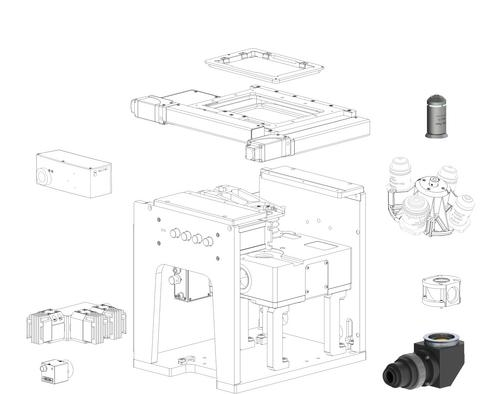
Your selection below will determine your system’s compatibility with either Zeiss, Nikon, or Olympus objectives. The optical performance of all system is equivalent.
Please note: The magnification of Olympus objectives will be 10% lower than the lens specification. This will not impact any other aspect of their optical performance.
Selecting an optical system will automatically add the appropriate MTC90 tube lens and camera mount assembly, and quick-change objective adaptor. The core MVR module, mounting brackets, power supply, and cabling kit are also automatically added. Objective lenses are not included.
| Zeiss ICS | ||
| Nikon CFI60 | ||
| Olympus |
More information about these options:
Zeiss ICS, Nikon CFI60 and Olympus optical systems use infinity corrected objectives and their optical performance is equivalent. These systems differ by where in the optical path they perform aberration compensation. The Zeiss ICS system corrects the lateral chromatic aberration from objectives in the tube lens. Nikon CFI60 and Olympus objectives correct for all aberrations in the objectives without relying on additional optics. This difference prevents Zeiss ICS objective lenses from being interoperable with objectives from Nikon or Olympus. Using 3rd party objective lenses with a Zeiss tube lens is not advised.
Since all aberrations are corrected at the objective lenses in the Nikon and Olympus optical systems, these objective lenses are interchangeable - with a few caveats. Firstly, the objective parfocal distance of Olympus objectives is 15 mm shorter than Nikon. This means that the stage height relative to the objective height needs to be adjusted by 15 mm if the objectives are to be interchanged. Secondly, the nominal tube lens focal length is 10% shorter in the Olympus system than in the Nikon system. As the final magnification of an objective is dependent on the ratio of its focal length to the tube lens focal length, this results in the final magnification of Olympus objectives being reduced by 10% if used with a Nikon tube lens. There is no other impact to their optical performance.
| Optical System | Nominal Tube Lens Focal Length | MVR Tube Lens / Camera Mount | MVR Tube Lens Focal Length | Parfocal Distance | MKR Supports | Objective Thread Type | Objective Adapter |
|---|---|---|---|---|---|---|---|
| Zeiss | 165 mm | MTC90C/D* | 165 mm | 45 mm | AB249 | M27 | AM172M |
| Nikon | 200 mm | MTC90N | 200 mm | 60 mm | AB176 | M25 | AM171M |
| Olympus | 180 mm | MTC90N | 200 mm | 45 mm | AB249 | RMS | AM173M |
*MTC90D is required for Zeiss optical system with MJB25 junction block
Olympus optical system compatibility in the MVR is achieved by combining a Nikon tube lens with mounting brackets that place the stage at the correct parfocal distance of 45 mm above the objective base flange. The use of the Nikon tube lens reduces the magnification of Olympus objectives by 10%.
For guidance on objective selection the Zeiss Campus, Nikon MicroscopyU, and Olympus Microscope Objective Introduction are very useful resources.