
LSQ-EC Series
High-speed motorized linear stages with built-in motor encoders and covers
About This Series
Zaber's LSQ-EC Series products are computer-controlled, motorized linear stages with integrated stepper motors and motor encoders. These stages are capable of speeds up to 1 m/s and can easily be mounted in XY or XYZ configuration without additional hardware. A rigid non-contact cover prevents the ingress of small objects. The built-in motor encoder allows for closed-loop operation and slip/stall recovery features. The stages are designed to connect directly to our MCC Family universal motor controllers, or they can be used with any 2-phase stepper motor controller through the panel mount DB15 connector. Set up is easy with AutoDetect. Once connected, the controller will automatically detect and configure the LSQ-EC.
Feature Callouts
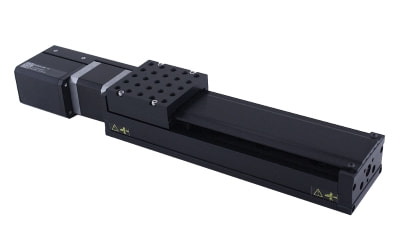
- Built-in motor encoder allows for easy slip/stall detection and recovery.
- Panel Mount DB15 with AutoDetect allows the LSQ-EC to be easily connected to an MCC Family controller and ready to use without additional user input.
- 200 step per revolution stepper motor with 500 CPR rotary encoder.
- Stage top supports Metric M6 threaded holes.
- Integrated recirculating ball bearing guide provides exceptional lifetime.
- LSQ-EC slides are available in a variety of travel lengths and lead screw pitches
- LSQ-EC stages can be assembled in XY or XYZ configuration without additional hardware
- Rigid non-contact cover protects internal lead screw and bearings.

Have a Question?
Contact us for device selection, troubleshooting & more!
Response time promise: 1 business day
Have a Question?
Easy Set-Up
With AutoDetect, the X-MCC controller will automatically detect and configure the peripheral. Zaber's devices can share both data and power through a daisy-chain, which reduces cabling and makes set-up as easy as 1, 2, 3:
- Connect the X-MCC controller to your computer.
- Connect the controller to the peripheral and plug in the power supply.
- Send instructions or automate your set-up using the Zaber Launcher.

For more details on daisy-chaining, read our technical article, "Daisy-chaining Data and Power to Reduce Cabling", or to determine which accessories you need for your system, try our Connection Guide Tool.
For additional information about setting up our devices, please visit our Support page, which includes our Getting Started Guide, Troubleshooting Guides, product user manuals, and other resources.